How a Prison Weapon Case Ended Before Closing Argument
Two Reasonable Explanations means Not Guilty
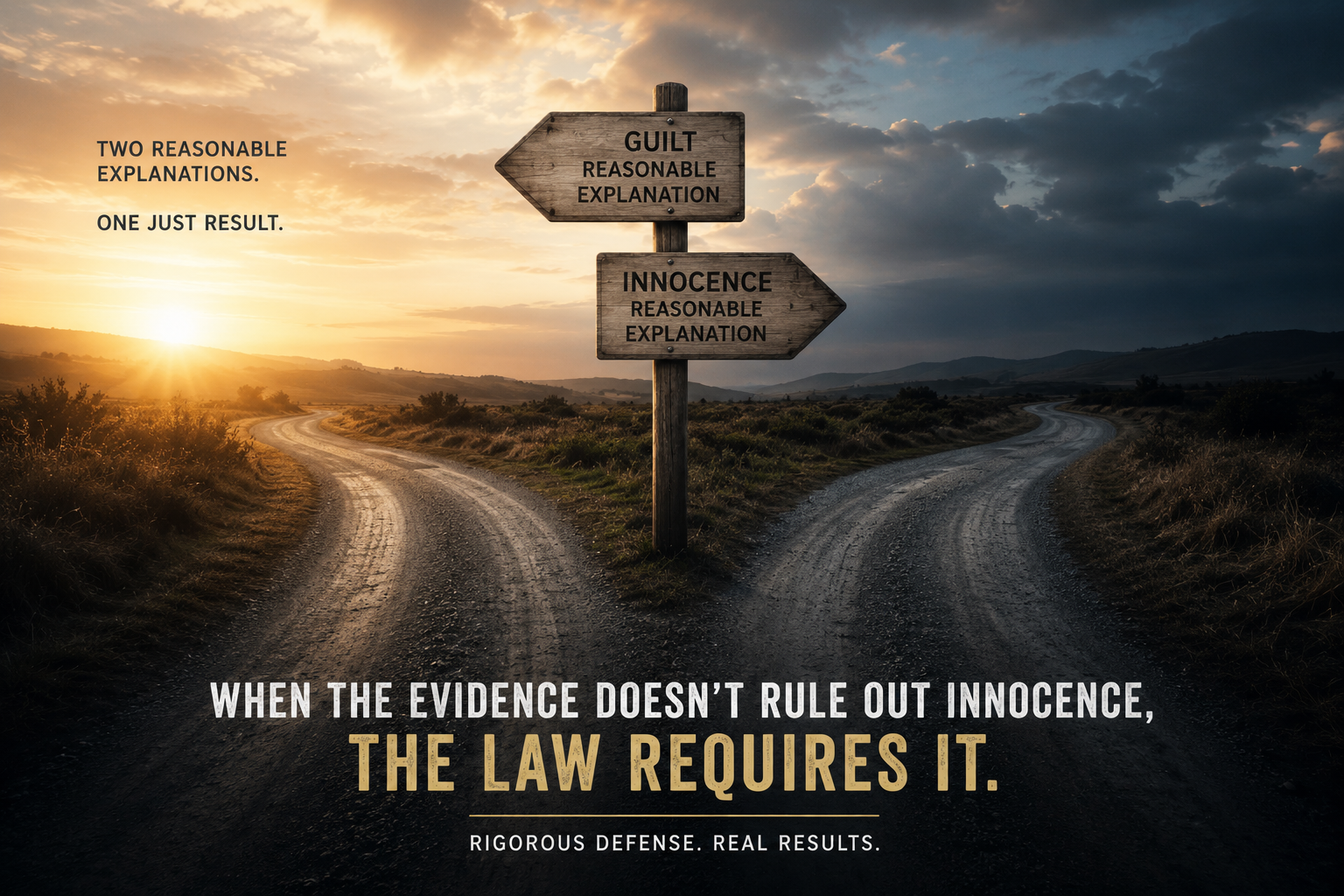
A California criminal defense case handled by Redding criminal defense attorney Jacob Levin ended with the prosecution moving to dismiss the charge after cross-examination exposed a fundamental problem: the evidence did not rule out a reasonable explanation consistent with innocence.
To protect the privacy of the individuals involved, this article does not use their real names. The client will be referred to as Mr. Smith, and the other inmate will be referred to as Mr. Jones.
Sometimes a criminal case turns on DNA, fingerprints, surveillance video, or a dramatic eyewitness.
Sometimes it turns on something much simpler.
A plastic tote. A name on a label. And one question:
Whose property was really inside it?
My client, Mr. Smith, was charged with possession of a weapon in a penal institution. The prosecution's case appeared straightforward. Officers searched property associated with a prison cell occupied by two inmates: Mr. Smith and Mr. Jones. Officers collected totes bearing the inmates' names, including one labeled with Mr. Smith's name. The officer testified that a suspected inmate-manufactured weapon was found during the search of Mr. Smith's tote.
But a label is evidence.
It is not necessarily proof.
And in a criminal case, the difference can be everything.
Two Inmates. Two Totes. One Critical Assumption.
The cell was assigned to two inmates: Mr. Smith and Mr. Jones. The evidence showed that the officers encountered a tote identified with Mr. Smith's name and another associated with Mr. Jones. The labels were already on the totes when officers arrived; The Officer testified that he had not put them there.
The prosecution's theory depended on a seemingly natural inference: if Mr. Smith's name was on the tote, the contraband inside it belonged to Mr. Smith.
But criminal defense often requires asking a different question:
What has the evidence actually ruled out?
My defense theory was that Mr. Jones could have placed or stored contraband in the tote bearing Mr. Smith's name.
I did not have to prove that Mr. Jones did so. The important question was whether the prosecution's evidence eliminated that reasonable possibility.
That distinction became the focus of cross-examination.
“Do You Have Any Evidence That Eliminates the Possibility?”
During cross-examination, the Officer acknowledged that, other than the name on the tote, he could not recall finding anything inside the totes tying their contents to a particular inmate. He also agreed that nothing on either cellphone found during the investigation identified its owner.
Then came the central issue.
I asked whether it was possible that the items belonged to Mr. Jones.
The officer initially said he found that difficult to believe—but acknowledged that it was possible.
Then I narrowed the question:
Did he have any evidence eliminating the possibility that the items belonged to Mr. Jones?
His answer:
“I don't.”
That was the heart of the defense.
This approach reflects what trial consultant and author David Ball describes as a “rule out” method of examining proof. Instead of trying to establish every detail of an alternative story, the defense focuses on what the government's investigation failed to eliminate.
The question becomes less about proving what happened and more about whether the prosecution can rule out a reasonable explanation consistent with innocence.
Then the Prosecution Pushed Back
On redirect examination, the prosecution attacked the defense theory.
The prosecutor emphasized that Mr. Smith's name was on the tote. The argument was essentially common sense: isn't someone's name on a container evidence that the contents belong to that person?
Even the court recognized the theoretical possibility that property inside a box bearing one person's name could belong to somebody else.
The prosecution then developed its own common-sense explanation. The contraband was valuable. Inmates generally protect their property. According to the officer, an inmate would not ordinarily want to place valuable contraband with somebody else's property.
That created the confrontation at the center of the case:
Which explanation made sense?
If You're Hiding Contraband, Would You Put Your Name on It?
On recross-examination, I returned to common sense.
An inmate can have property in a cell that is not labeled. The officer agreed with that proposition.
So I asked:
Does it make sense to hide contraband and put your own name on it?
The officer initially explained that hiding something “in plain sight” could make sense.
Then I asked the more important question: wouldn't it make more sense to hide contraband without putting your own name on it?
The officer agreed:
“That makes sense, yes.”
The prosecutor responded again. His theory was also plausible: perhaps an inmate would label the tote as his because he expected the concealed contraband never to be discovered.
The officer agreed that explanation could make sense too.
At that point, something important had happened.
The prosecution had a reasonable explanation.
The defense had a reasonable explanation.
So I asked one final question.
“Would You Say That There's Two Reasonable Explanations?”
The prosecutor's explanation made sense to the officer.
My explanation made sense to the officer.
I asked:
If both explanations make sense, are there two reasonable explanations?
The prosecutor objected, arguing that the question called for a legal conclusion.
The judge overruled the objection.
The officer answered:
“Yes, there's two.”
That answer mattered because of a fundamental rule governing circumstantial evidence in California criminal cases.
CALCRIM No. 224 and Two Reasonable Conclusions
I had planned to make CALCRIM No. 224, California's circumstantial-evidence instruction, a central part of closing argument.
Under CALCRIM No. 224, before circumstantial evidence can support guilt, the jury must be convinced that guilt is the only reasonable conclusion supported by that evidence. When circumstantial evidence supports two or more reasonable conclusions—one pointing toward innocence and another toward guilt—the jury must accept the reasonable conclusion pointing toward innocence.
That principle fit the defense precisely.
The prosecution's explanation: Mr. Smith labeled his own tote and concealed his own contraband inside it.
The defense explanation: with two inmates sharing the cell, Mr. Jones could have stored contraband in the tote bearing Mr. Smith's name—and the investigation had not produced evidence eliminating that possibility.
The officer had now agreed that there were two reasonable explanations.
I was preparing to take that testimony directly into closing argument.
I never got the chance.
The Prosecution Moved to Dismiss
After the officer's testimony, the prosecution moved to dismiss the case.
There would be no need for the closing argument I had prepared around CALCRIM No. 224.
The case was over.
For my client, the distinction between an assumption and proof had become decisive.
Criminal Defense Means Testing What the Evidence Does Not Prove
This case illustrates something important about criminal defense.
Evidence can look powerful at first glance.
A weapon found in a tote bearing the defendant's name certainly creates an inference. A prosecutor can argue from that fact. A jury can consider it.
But the existence of incriminating evidence is not the end of the analysis.
A criminal defense attorney must examine the assumptions connecting the evidence to the accusation.
Does the evidence prove possession?
Does it prove knowledge?
Does it identify who actually placed an item somewhere?
Did investigators rule out other reasonable explanations?
And perhaps most importantly:
Is the prosecution's explanation the only reasonable explanation?
Those questions can change a case.
Redding Criminal Defense Attorney Jacob Levin
Jacob Levin is a Redding criminal defense attorney representing people accused of crimes in Northern California. At Jacob Levin Law, criminal cases are examined not only for what the prosecution's evidence appears to show, but also for the assumptions, unanswered questions, and reasonable alternative explanations that may exist beneath the surface.
If you are facing criminal charges and are looking for a criminal defense lawyer in Redding, California, contact Jacob Levin Law to discuss your case.
Every criminal case is different, and past results do not guarantee future outcomes. The names used in this article have been changed to protect privacy. The result described above is based on the particular facts and circumstances of that case.